Sandwich Runner
- 4.1
- Rating
- 100.00M
- Installs
- Free
- Price
 Analysis by App-foxy
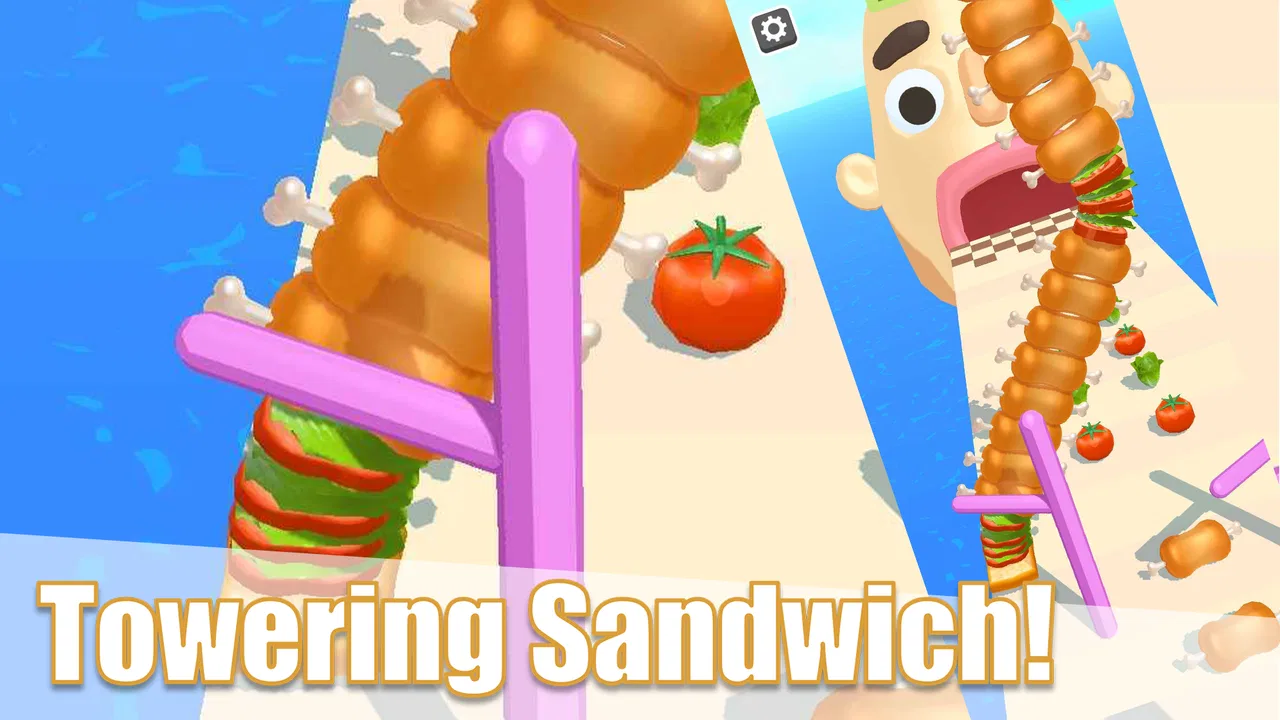
Sandwich Runner is the kind of action game I reach for when I want something immediate, colorful, and easy to understand without committing to a long session. The basic idea is wonderfully clear: guide a sandwich through a running course, collect useful ingredients, avoid the bad choices, and try to finish with the tallest or most satisfying stack possible. I found it approachable within seconds, but the simple presentation hides a few decisions that matter more than they first appear.
That simplicity is a big part of its appeal. I did not need a tutorial-heavy introduction or a complicated control scheme before I could start playing. The game presents a familiar runner format and gives it a food-building twist, so the objective is visible on the screen as I move. It is free to download, aimed at Everyone, and works on devices running Android 9 or later. The current version is 0.3.48, while the game itself first appeared on October 27, 2021.
Sandwich Runner is developed by 株式会社ドワンゴ, and its reach is easy to understand: it has passed over 100 million installs, with an average rating of 4.1 from around 73 thousand ratings. Those figures do not make it automatically perfect, but they do reflect a game that has found a broad audience. My own impression is that it works best as a short-break game rather than as a deep action experience.
You May Also Like

 Blood Strike: 2.5 Anniversary
Blood Strike’s Loadouts Turn Every Drop Into a Tactical Gamble
A close look at Blood Strike’s custom loadouts: how fast access to signature weapons reshapes its battle royale rhythm, rewards preparation, and narrows the gap between fights.

 Pandora - Music & Podcasts
Pandora’s Music Is Easy to Start, but Harder to Recover
Pandora’s strength is its low-effort path from a seed to a station. Its weak spot is how much confidence it asks you to place in connection, setup, and quiet recovery.

 8 Ball Pool
 Is Built on Rivalries, Rematches, and Routine
A close look at the rivalries, rematches, shared routines, and unanswered safety questions that turn a quick pool match into a persistent mobile community.

 Samsung Music
’s Quiet Strength Is Playing What You Already Own
Its reach comes less from spectacle than from dependable access to a personal library. That simplicity is both the app’s strongest retention engine and its ceiling.

 AccuWeather: Weather Radar
AccuWeather Review: A Quick, Clear Forecast for Everyday Decisions
For everyday plans, the best forecast is the one you can understand quickly. AccuWeather makes rain timing, radar, and local conditions easy to act on, with a few trade-offs.

 Hill Climb Racing
Why Hill Climb Racing Still Turns Crashes Into One More Run
A tiny car, a bumpy hill and one more upgrade: Hill Climb Racing keeps resurfacing because its simple chaos makes every near-miss feel personal.
More From Our News Desk



How the sandwich run actually feels
The main interaction is based on movement and quick choices. I guide the runner from side to side, aiming for ingredients that improve the sandwich while steering away from obstacles or less desirable items. The path is designed to make each decision readable at a glance. That matters because the game moves quickly enough that stopping to analyze every object would defeat the purpose.
What makes the format enjoyable is the visible result of each choice. A good run does not merely increase an invisible score; it changes the sandwich I am building. That gives the course a clear visual goal. I can look at the stack and immediately understand whether the run is going well, which is more satisfying than collecting abstract points that never affect the screen.
The controls are also a good match for touchscreens. I can make small corrections when an ingredient is near the edge of the route, then shift quickly when the course presents a wider choice. This is one of the first useful habits I developed: I stopped chasing every attractive item and began positioning early instead. A slightly lower-value pickup is often better than a risky last-second move that sends the sandwich into a penalty.
That early positioning makes the game feel more deliberate than its bright, casual appearance suggests. The best runs are not simply about reacting as fast as possible. They involve reading the next section of the path, choosing a lane, and accepting that one missed ingredient is preferable to losing control. For younger players or anyone new to runners, this creates a gentle introduction to risk and reward without burying the lesson in complicated rules.
The pressure comes from decisions, not complicated controls
Sandwich Runner creates pressure by putting desirable and undesirable choices close together. I often found myself making a decision before I had complete certainty about the safest route. That uncertainty is where the action comes from. If every useful ingredient were placed in an obvious line, the game would become a visual checklist instead of a runner.
A practical approach is to treat the course in short segments. I focus on the next immediate group of objects rather than staring at the finish. This reduces frantic swiping and makes it easier to recover after a mistake. On a crowded section, I prioritize maintaining a clean route over collecting everything. The sandwich may be smaller, but a controlled run is usually more satisfying than a greedy attempt that collapses near the end.
I also recommend using the first moments of a run to establish a rhythm. Instead of making large movements immediately, I watch how much space is available and keep the character near a position that allows access to both sides. Staying too far left or right can turn the next choice into a forced mistake. This is a small adjustment, but it made my runs feel noticeably less chaotic.
The pressure is not especially punishing in the way a demanding arcade game can be. Rather, it is a light form of concentration that fits short play sessions. I could play while waiting for an appointment or during a brief break without needing to remember a complicated story or rebuild a strategy from a previous session. That makes the game convenient, although players seeking serious long-term challenge may eventually find the format repetitive.
Progress is easy to understand, but depth is limited
The game’s strongest sense of progress comes from improving individual runs and learning how to handle the route. I enjoyed trying again after a poor result because the failure usually felt connected to a visible decision: I moved too late, aimed for too much, or failed to leave room for the next choice. That kind of immediate feedback is more useful than a vague feeling that I simply performed badly.
At the same time, this is not the sort of action game I would choose for complex character development, deep equipment planning, or a large strategic campaign. Its attraction is the compact loop of moving, collecting, building, and finishing. If you want a game with extensive systems that keep unfolding for many hours, this is probably the wrong place to look. The appeal depends on whether repeating a polished short activity sounds relaxing or monotonous to you.
One of the more useful ways to play is to set a personal objective before starting. I might focus on finishing without taking a risky route, or I might try to build the best-looking sandwich possible rather than simply moving as quickly as I can. These self-imposed goals give the short runs more variety without pretending that the game is a full competitive simulator.
For parents considering it for a child, the Everyone content rating and straightforward food-based theme make the premise approachable. I would still suggest checking the device and purchase settings before handing over a phone, especially because the game includes in-app purchases. The game itself is free, but free access and completely cost-free play are not the same thing.
Spending is clear in one important respect
The listed purchase structure is $2.99 per item. That is the concrete spending detail I would keep in mind before installing. It tells me that optional purchases exist and that the cost is attached to individual items rather than being presented as a single paid download. I would not describe the game as requiring payment to start, because it is free, but I also would not treat it as a purchase-free experience.
For my own use, the sensible approach is to decide in advance whether I am willing to spend anything at all. Casual runner games can make a small purchase feel harmless in the moment, particularly after a frustrating run. Setting a device-level purchase restriction or asking the account holder before buying is a practical safeguard, especially when children use the same device.
I am careful not to claim that purchases make the game easier, faster, or more competitive, because the confirmed purchase information does not establish what each item does. That distinction matters. A price tells me that buying is possible; it does not, by itself, prove that spending is necessary or that non-paying players are disadvantaged. My fairness judgment therefore rests on what can be observed in play rather than on assumptions about the shop.
From a trust perspective, I prefer this kind of honest boundary. I can say that the game is free to download and contains $2.99 individual purchases. I cannot responsibly promise that every progression element is available without spending or that purchases never affect performance. Anyone especially sensitive to monetization should approach it as a free game with optional paid items and make the decision based on their own tolerance.
Is the challenge fair?
In normal play, the challenge feels tied mainly to route reading and movement timing. When I made a mistake, I could usually identify the moment that caused it. That gives the game a fairer feel than a runner where failure appears random or where the controls seem to ignore careful input. The sandwich-building objective also helps because the consequence of a choice is visible instead of hidden behind a complicated scoring formula.
Still, visual simplicity does not mean every moment will feel equally comfortable. Quick lane changes can be stressful when several objects appear close together, and a player using a smaller screen may find crowded sections harder to read than someone with more display space. I would not call that a confirmed device-specific flaw, but it is a real consideration for touch control: screen size and finger placement can affect how confidently you react.
The most reliable fairness strategy is conservative play. I aim for a route that I can clearly reach rather than the most tempting collection of ingredients. This creates a useful trade-off: the spectacular sandwich may require more risk, while a safer route produces a more consistent result. Players who enjoy optimizing every run will appreciate that choice, but players who expect the game to reward maximum speed every time may find cautious play less exciting.
Compared with traditional endless runners, Sandwich Runner is less focused on surviving an indefinitely extending course. Its food-building goal gives each attempt a stronger sense of completion. Compared with action games built around combat, it removes attacks, equipment, and complex enemy patterns, replacing them with movement decisions and visual accumulation. That makes it easier to pick up, but also means there is less room for advanced mastery.
Compared with puzzle games, it demands more real-time reaction and offers less opportunity to pause and calculate. Compared with competitive multiplayer games, it is much less socially pressured because the core experience is a personal run rather than a direct contest. I would choose it over those alternatives when I want a quick, low-commitment challenge, but I would choose a deeper runner or action title when I want a longer-term skill ceiling.
Small habits that improve the experience
The first habit I recommend is to stop treating every ingredient as mandatory. The sandwich may encourage collection, but the route still has to be navigated. Leaving one item behind can preserve the line needed to reach a better opportunity later. This is especially helpful for new players who instinctively swipe toward the nearest reward and then discover that the next obstacle is unreachable.
The second is to make movements earlier than feels necessary. Touch controls reward preparation because a late swipe can carry the character too far or leave no time to correct. I found that moving toward the next lane while the current section was still open gave me more control than waiting until the object was directly beside me.
The third is to use unsuccessful runs as route-reading practice rather than immediately repeating the same movement. Before restarting, I think about whether the mistake came from choosing the wrong lane, moving too late, or trying to collect an item that was never worth the risk. That short reflection turns repetition into learning instead of simple frustration.
A fourth useful approach is to play in a setting where short attention is acceptable. This is not a game I would start during a task that requires uninterrupted concentration, because the action can demand quick reactions. On the other hand, it fits a commute break, a waiting room, or a few minutes after finishing work. The sessions feel self-contained, so I do not need to reserve a long block of time.
Who should play it, and who should skip it?
I would recommend Sandwich Runner to someone who enjoys colorful casual action, quick touch controls, and goals that can be understood immediately. It is particularly suitable for players who like seeing their decisions represented visually. Building a sandwich gives each run a playful identity, and the food theme is more inviting than a purely abstract obstacle course.
It is also a reasonable choice for a younger or less experienced player who wants an action game without combat complexity. The Everyone rating supports that broad accessibility, while the free entry point makes it easy to try. I would still keep the purchase setting in mind for shared devices, since the game offers individual paid items.
I would skip it if my priority were a detailed campaign, a substantial competitive ladder, or a game that constantly introduces new strategic systems. I would also look elsewhere if repeated short runs feel like busywork to me. The central pleasure comes from refining movement and enjoying the sandwich result; once that loop stops being satisfying, there is not a deep role-playing system waiting underneath to replace it.
Players who dislike monetization in free games should make a deliberate choice before installing. The game costs nothing to download, but the presence of $2.99 purchases means it is not the same as a fully paid, one-time experience. Because the available facts do not establish the practical effect of those items, I would judge the spending side personally after seeing the purchase prompts and deciding whether they interfere with my preferred way to play.
My trust verdict after weighing the trade-offs
Sandwich Runner earns its popularity honestly through a clear idea and an easy first step. I understood what to do almost immediately, and the sandwich itself gave every movement a visible purpose. The game is at its best when I play it as a compact action snack: read the route, choose a sensible line, accept a missed ingredient, and enjoy the result at the finish.
Its limitations are just as clear. The format is intentionally narrow, so it may not satisfy anyone looking for deep progression or a major action adventure. The free model includes individual purchases, and the confirmed price of $2.99 per item is worth remembering before a child or another account user begins playing. I also would not make claims about competitive advantage from those purchases without direct evidence of what they provide.
The rating of 4.1 from around 73 thousand ratings and the scale of over 100 million installs suggest that the accessible formula works for many people, while the roughly 1.3 thousand written reviews show that players have taken the time to discuss it. I see it as a dependable casual recommendation rather than a must-have for every mobile gamer.
If a friend asked me whether to try it, I would say yes, provided they want short, touch-driven action and are comfortable with a free game that offers paid items. I would advise playing conservatively at first, learning to position early, and judging the purchase experience for themselves instead of assuming that spending is required. For that audience, Sandwich Runner is a cheerful and easy-to-return-to game with just enough pressure to make a quick run feel worthwhile.
FAQs for Sandwich Runner
01What is Sandwich Runner about?
Sandwich Runner is a casual mobile game where players stack ingredients to create the tallest and tastiest sandwiches while navigating through various obstacles. The objective is to build the sandwich as high as possible without dropping any ingredients, offering a fun and engaging experience for all ages.
02Is Sandwich Runner free to play?
Yes, Sandwich Runner is free to download and play on both Android and iOS devices. However, it offers in-app purchases, which can be used to unlock additional features, power-ups, or to remove ads, enhancing the overall gameplay experience.
03What are the minimum device requirements for Sandwich Runner?
Sandwich Runner requires iOS 10.0 or later for Apple devices and Android 5.0 and up for Android devices. The game is optimized for both smartphones and tablets, ensuring smooth performance across a wide range of devices. Ensure your device meets these requirements for the best experience.
04Does Sandwich Runner require an internet connection?
No, Sandwich Runner can be played offline, making it perfect for on-the-go entertainment without needing a constant internet connection. However, an internet connection is required for in-app purchases or to access online leaderboards and updates.
05Are there any ads in Sandwich Runner?
Yes, Sandwich Runner includes ads, which help keep the game free for all players. Ads can appear between levels or during gameplay. Players have the option to remove ads through a one-time in-app purchase, creating an uninterrupted gaming experience.
Pros
- Engaging and fun gameplay mechanics.
- Colorful and appealing graphics.
- Easy to learn for all ages.
- Regular updates with new levels.
- Smooth performance on most devices.
Cons
- Repetitive after extended play.
- In-app purchases can be pricey.
- Limited multiplayer options.
- Occasional ads interrupt gameplay.
- Requires internet connection to play.

Sandwich Runner
Gallery